In this guide
A schedule label is not the whole pattern
“Various,” a stated daily span, and a note about work outside normal hours communicate different things. Read them together. A schedule comparison should retain the base pattern, any stated variation and the questions the notice leaves open. Do not infer an individual's assigned shift, overtime, seniority rights or availability obligations from a general occupation description.
Public MTA postings provide role-specific examples of schedule wording. BLS offers broader U.S. occupational context. The sources have different scopes. A national description of irregular hours does not establish what a particular vacancy will require, and a single office-hours example does not describe all work at the employer.
Use a pattern card
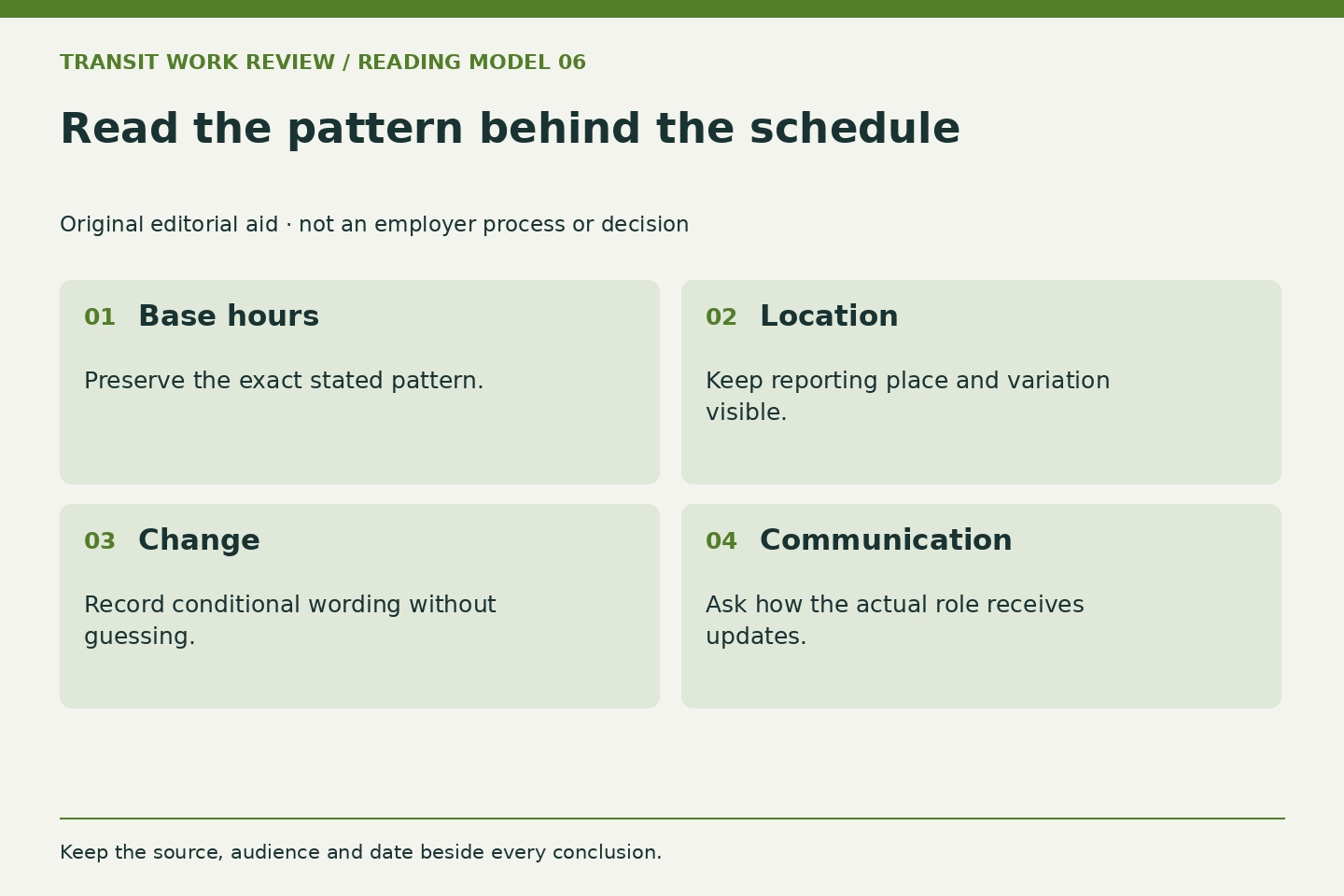
Our editorial pattern card has four fields: stated hours, location, variation and communication. The first three begin with the notice. The fourth is often a question: how are assignments or changes communicated for this role? Record what is known and leave the rest blank. A blank is more accurate than a reassuring assumption.
Consider a hypothetical notice listing weekday hours with occasional work elsewhere. A reader can note the base span and the possibility of location variation, then ask what “occasional” means in that team's context. They should not turn that phrase into a fixed number of days or assume that the normal reporting site is always available by their usual travel route.
Keep personal planning separate
A personal schedule decision may involve travel, care responsibilities, study or other commitments. This publication does not need those details. Use the verified work pattern to identify your own constraints privately, then ask the employer only the relevant role question. Do not disclose another person's health or family information in an informal request for general scheduling context.
A useful private exercise is to distinguish a non-negotiable constraint from a preference and an unanswered question. The exercise cannot determine whether an arrangement will be approved. It helps prevent a preference from being mistaken for a stated term or an uncertainty from being ignored until after a decision.
Confirm the source of the answer
A recruiting conversation, a general webpage and a written employment document may carry different weight. Keep the date and context of each answer. If two sources appear inconsistent, ask which applies to the role and employee category. Do not resolve the inconsistency by choosing the version you prefer.
The purpose of schedule research is not to predict every day. It is to understand the conditions that could materially change a decision and identify who can clarify them. A well-labeled pattern card makes the conversation specific while leaving assignment, policy and individual arrangements with the employer.
Continue reading: Build a small proof index for your application, Internal mobility still needs a current notice, What a transit pay figure can and cannot tell you.