In this guide
Preserve the identity of the posting
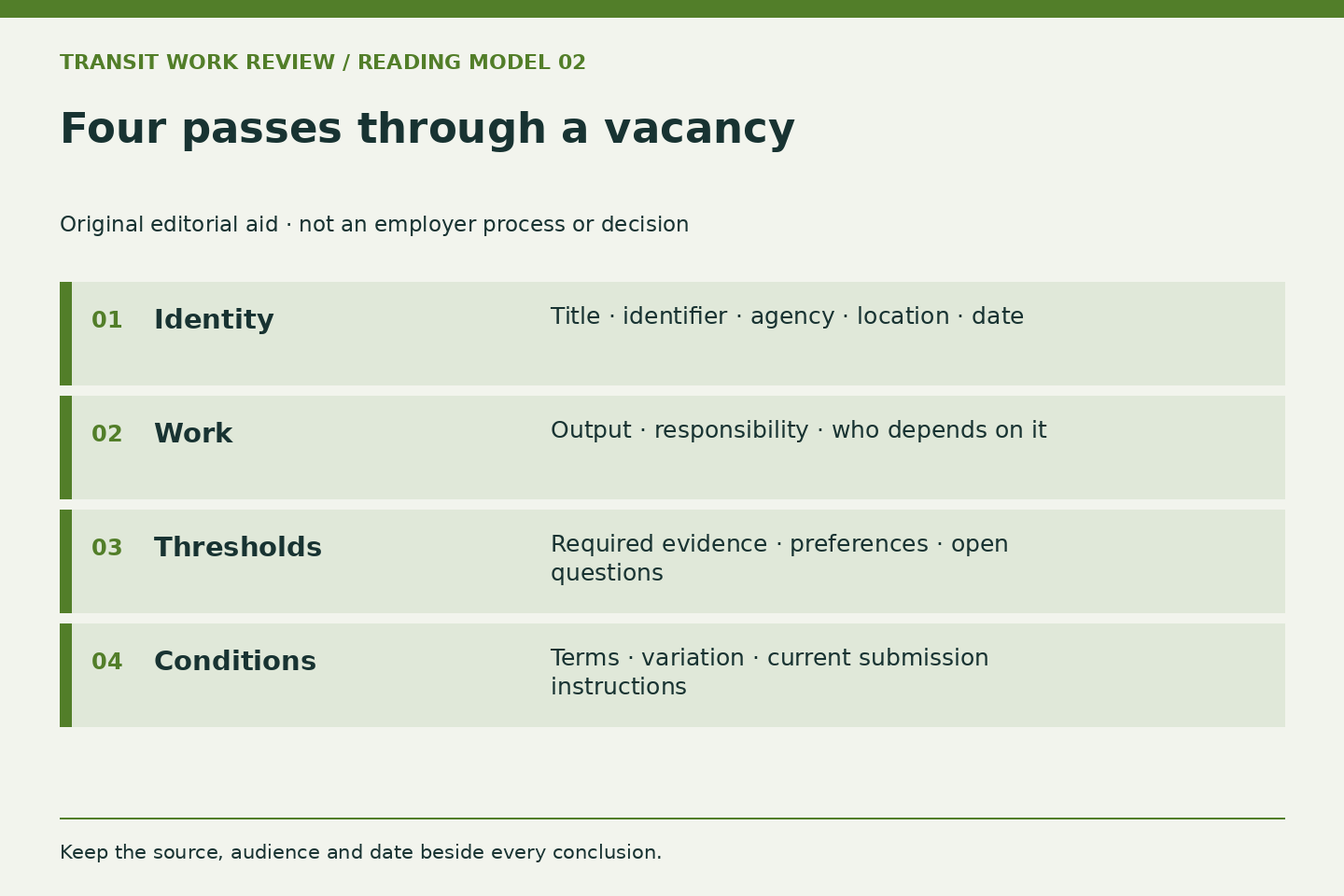
Begin a vacancy note with the exact title, job identifier, business unit, location, posting date and the date you reviewed it. These details are not decoration. They allow you to return to the same evidence when a title appears in several agencies or a listing is revised. Save an appropriate personal reference to the public posting; do not assume that a search-result snippet contains its full conditions.
Two public examples checked on October 1, 2026 illustrate why identity matters. Job 14792 was an MTA Headquarters software-engineering posting dated September 10. Job 17263 was a Brooklyn depot-support leadership posting dated September 29. Their responsibilities and conditions belong to their own notices. This article uses them as reading examples, not recommendations, open-vacancy guarantees or a statement that readers meet either role's requirements.
Read duties before keywords
Read the duties once without looking for yourself. Identify the work product, who uses it, and what the role must keep dependable. A technology list may catch the eye, but a posting can also place responsibility on testing, documentation, supplier work or supporting a service. A budget-related title can include coordination beyond calculating figures. Do not let the most familiar noun hide the actual responsibility.
Now make a three-column private worksheet: duty, evidence you could discuss, and uncertainty. Keep each duty in plain language. A hypothetical “maintain accurate status reports” duty could connect to a real example of reconciling inconsistent records. It would not justify claiming experience with a system you have never used. Mark that missing system experience as a question or development need rather than inserting its name into your history.
Keep thresholds and preferences distinct
A notice can contain required qualifications, preferred experience, special conditions and instructions that apply only to a stated applicant group. Read the entire document before sorting them. Where the wording is ambiguous, preserve the exact requirement in a private note and ask the recruiting contact through the official route. This publication cannot decide whether an equivalency is accepted, a credential is sufficient or an internal rule applies.
Consider a hypothetical applicant whose experience is relevant but whose qualification does not match the wording neatly. The useful next step is to document the actual credential, dates and relevant responsibilities and ask about the stated equivalency provision if one exists. It is not to rewrite a requirement as optional because other parts of the role feel familiar. Equally, a preferred skill should not silently become a self-imposed mandatory threshold.
Read conditions as a separate pass
After duties and thresholds, read location, work pattern, status and compensation wording. A normal-hours description and an additional requirement for work outside those hours can coexist. Copy both into the comparison. A telework statement may describe eligibility to apply, not an unconditional arrangement. The point is to retain the qualification attached to a term instead of reducing the entire paragraph to a benefit label.
For a worked reading exercise, imagine a notice that gives a weekday schedule and adds that service needs can require other hours. Your note should have separate entries for baseline hours, stated variation and the question still unresolved. A useful conversation might ask how often the variation occurs for that team and how scheduling is communicated. That asks for context; it does not presume an entitlement or an operational promise.
Distinguish a deadline from a process estimate
Application closing dates, anticipated test dates and later selection stages are different kinds of time information. Record the label beside each date. An exam route can have its own Notice of Examination and updates; a vacancy listing may have another selection method. Do not combine dates from two superficially similar positions into one imagined sequence. When a document changes, compare its identifier and revision before replacing your note.
Build an application checklist from the actual instructions, not from an online article about a different role. The checklist should name each requested item, its current version and whether submission was confirmed through the official process. Preparing a document is not the same as submitting it. A saved draft is not evidence of receipt. Keep confirmation information privately and never send credentials or application records to this publication.
A decision note that survives a second reading
End with five short statements: the work I understand, the requirements I can evidence, the requirements needing clarification, the terms I have actually seen, and the action required by the current notice. This is an editorial reading method, not an employer scoring system. It helps expose the difference between a promising role and an assumption that happens to sound promising.
Before acting, reopen the official posting and check that the identifier and instructions still match. If the role is closed or the terms changed, your research remains useful as a dated example but no longer establishes a current opportunity. Avoid silently substituting a similar job. A reliable application starts with a reliable reference, and a careful reader should be able to show exactly which document informed the next step.
Try the Responsibility Bench to prepare a bounded question.
Continue reading: What a transit pay figure can and cannot tell you, Route the question before sending the record, Transit technology work is a service question.