In this guide
Start with a service dependency
A train arriving at a platform is the visible result of many responsibilities. The vehicle must be available, the infrastructure usable, information understandable and records dependable. A career search becomes more useful when it starts with one of those dependencies. Instead of asking only whether you want to work with trains, ask what kind of problem you want to become reliable at solving. This editorial map describes ways to think about the work; it is not an MTA organization chart.
The MTA Career Center presents a broad set of career areas, and its agency directory identifies distinct operating organizations. Those sources establish breadth. They do not make a role in a railroad equivalent to a similarly named role in bus or subway operations. Put the agency and actual vacancy beside every title in your notes. A familiar public-facing brand is a starting context, not a complete employment description.
Five responsibilities to investigate
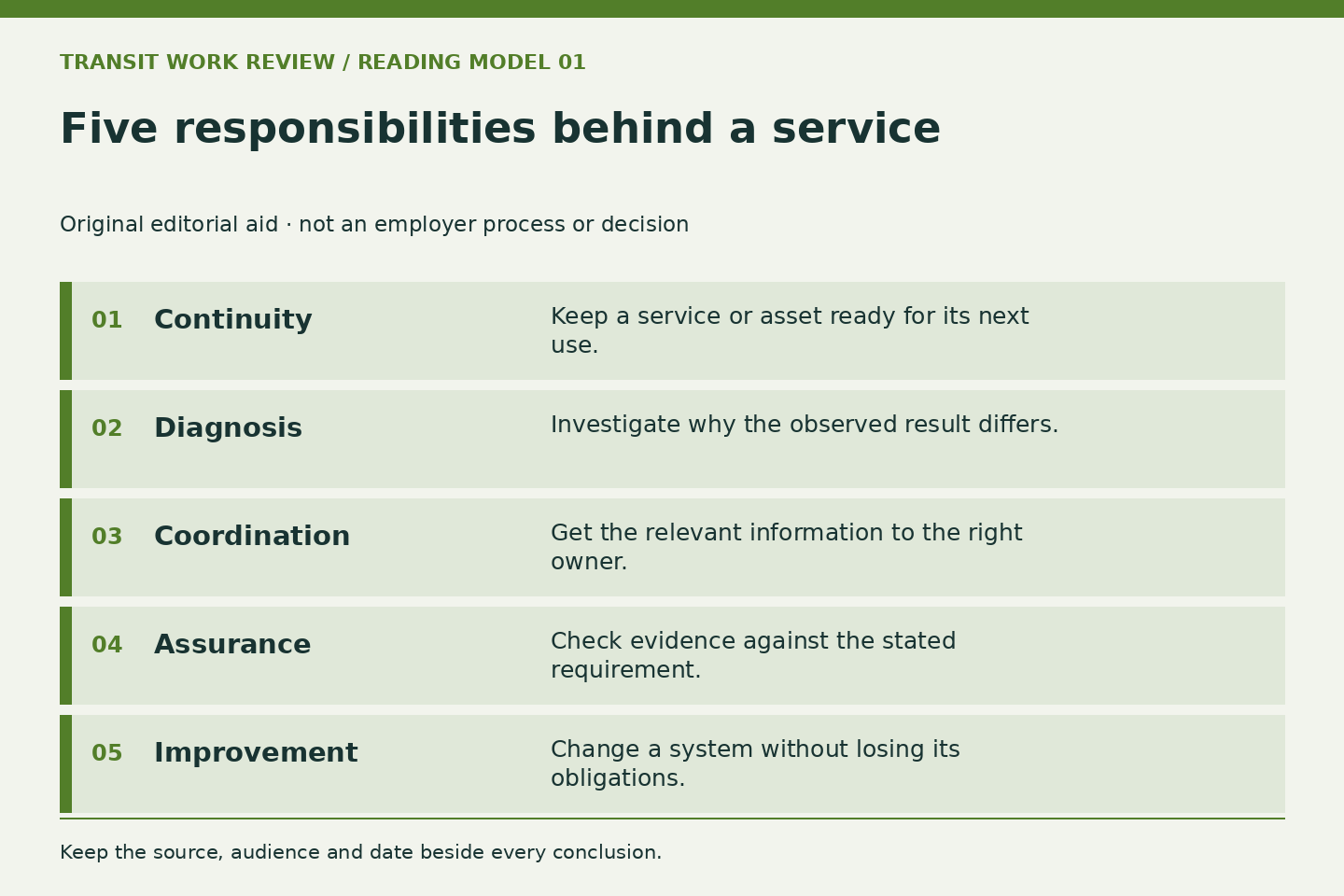
Our first lens is continuity: keeping a service or asset ready for its next required use. The second is diagnosis: finding why something does not behave as expected. The third is coordination: getting the right information to the person who can act. The fourth is assurance: checking whether evidence meets a requirement. The fifth is improvement: changing a system while preserving the obligations it already serves. These responsibilities overlap, but the balance differs between jobs.
Use a small example outside transit to identify your own evidence. In a hypothetical community equipment library, one volunteer prepares returned items, another investigates recurring faults, and another keeps the availability list accurate. Each contributes to a dependable service. The example helps distinguish responsibilities; it does not qualify someone to maintain transit equipment. Transfer the reasoning and habits you can demonstrate, while leaving specialized competence and authorization with the relevant employer.
Separate family, setting and level
A role family describes a broad kind of contribution. A setting describes where and under what conditions it happens. A level describes the responsibility and judgment expected. These three dimensions are often compressed into one job title. Unpack them. A technical analyst supporting a live service, an analyst preparing long-range plans and an analyst checking financial records may share spreadsheet skills while answering to very different deadlines and consequences.
For each role under consideration, write one sentence beginning with “This role is responsible for…” Then write a separate sentence beginning with “The work happens in…” Finally, mark the decisions the person owns, recommends or escalates. If the posting does not say, leave a question. Do not turn a general career page into an invented duty statement or assume that a managerial-sounding title includes hiring authority.
A worked comparison: repair and coordination
Imagine comparing two hypothetical advertisements: one asks for diagnostic work on equipment; the other asks for coordinating maintenance records. The first comparison is not which sounds more important. It is what evidence each needs. The diagnostic role might call for documented technical preparation and task-specific experience. The coordination role might require accurate status tracking, communication and an understanding of when a record is incomplete. Actual thresholds must come from each notice.
Your preparation sheet could have three lines per role: strongest relevant example, missing evidence, and one question about the working environment. A personal project showing careful measurement may support a diagnostic discussion without replacing a required credential. A scheduling example can support coordination without proving knowledge of the employer's systems. This distinction lets you present useful experience honestly instead of stretching a familiar example until it means everything.
Use occupation profiles carefully
National occupation profiles can supply vocabulary and reveal questions you had not considered. The BLS railroad-workers profile is a U.S. occupational overview, not a specification for every MTA role. Read the occupation definition before borrowing its statistics or descriptions. Do not carry a national median into a local offer comparison, or assume that a broad railroad category covers a particular subway title in the same way.
A practical sequence is to read a broad profile, identify two unfamiliar responsibilities, and then return to the actual employer notice to see whether either appears. If not, keep them as background. The employer's application requirements remain their own evidence category. This habit prevents research volume from becoming false certainty: a thick folder of general information can still leave the decisive condition unanswered.
Finish with a bounded shortlist
Keep no more than three distinct role hypotheses in an initial shortlist. Give each a reason grounded in the work, one example of your preparation and the exact source that could disprove your assumption. “I enjoy solving problems” is too broad to guide a choice. “I want to investigate recurring equipment faults, and I need to check the required technical background for this vacancy” gives the next research session a purpose.
Revisit the shortlist when a current posting changes the picture. You may discover that the setting is a better fit than the title, or that a useful bridge role offers evidence you do not yet have. This is career exploration, not an eligibility verdict. The result should be a clearer question and a smaller evidence gap, with agency, geography and date still visible. That is a more durable outcome than memorizing a list of transit job names.
Try the Responsibility Bench to prepare a bounded question.
Continue reading: Read an MTA posting as a set of commitments, My MTA Portal: the public workforce context, Engineering careers: show the decision trail.