In this guide
Attach a label before comparing a number
A compensation figure becomes meaningful only when its unit and scope travel with it. Record whether it is hourly or annual, the named job or occupation, location, employer or population, period and source. Also preserve words that qualify it. An expected range, a contractual rate, a national median and a written offer are different forms of evidence even when all are expressed in dollars.
As a dated example, the MTA Headquarters Advanced Software Engineer posting, job 14792, dated September 10, 2026, showed a salary range of $140,828–$166,223 for a New York role when checked October 1. That is evidence about that posting. It is not a salary promise for applicants, a general MTA technology pay scale, or a figure that should be applied to a represented operational position.
Use four separate evidence envelopes
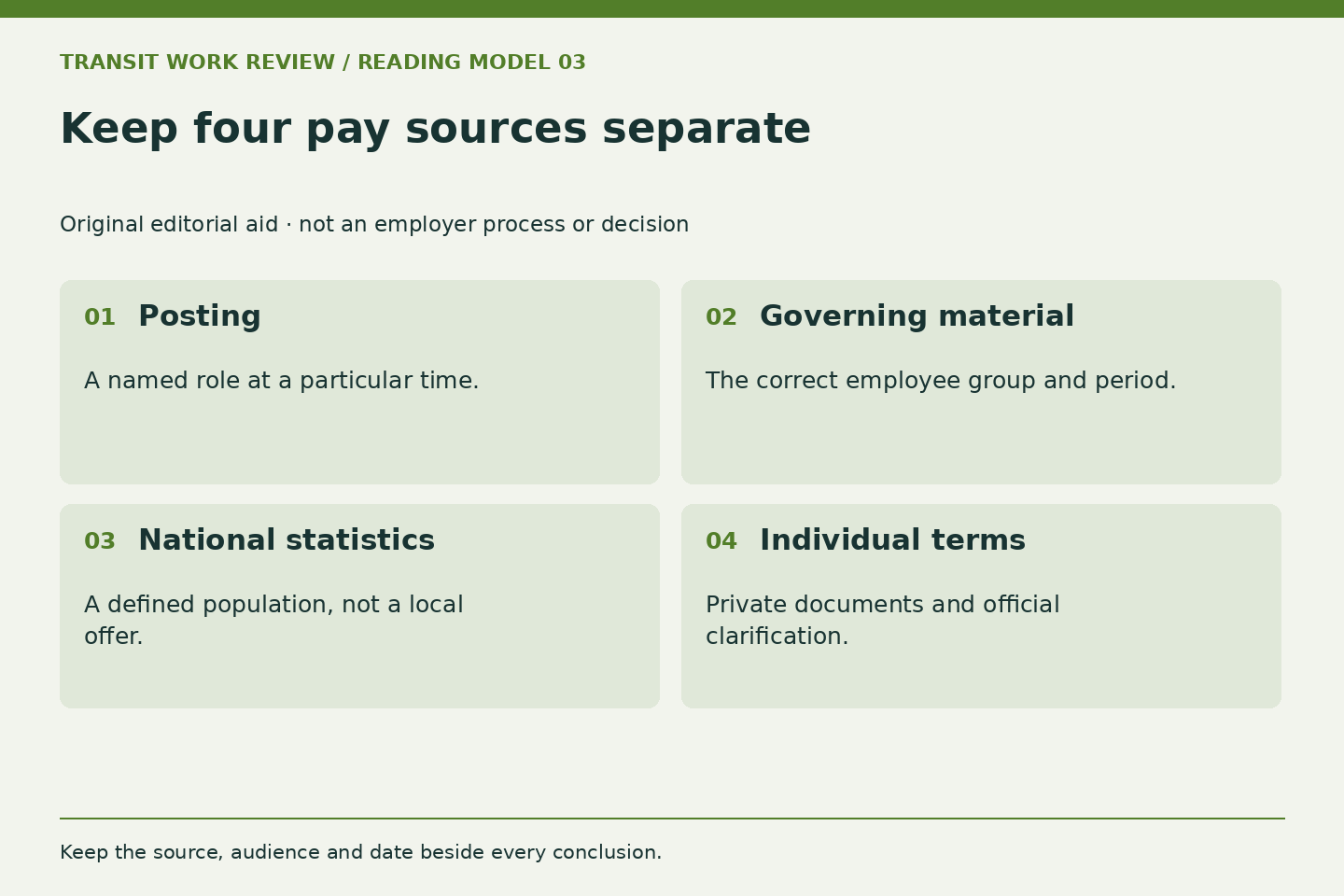
The first envelope contains the public job notice. It tells you what that employer states for the position at that time. The second contains any applicable governing pay material whose audience you can establish. The third contains broader labor-market statistics, useful for context but not a substitute for employer terms. The fourth contains the individual's written offer or official employment information, which must stay private and be interpreted through the responsible employer channels.
Keeping these envelopes separate prevents a common reasoning error. Someone sees a high endpoint in a vacancy and a national occupation median, then treats the difference as room for a guaranteed negotiation outcome. Neither source establishes that conclusion. A better note says what each source measures and identifies the missing term. The question may concern starting placement, work pattern or an applicable employee category, not arithmetic.
Work through a fictional comparison
Imagine two hypothetical postings. One states an hourly rate; the other states an annual range. The first also leaves weekly hours unclear, while the second describes a variable schedule. Simply multiplying the hourly rate by an assumed full-time year creates precision from an unverified input. Your comparison should flag the hours assumption instead of publishing a calculated winner. Actual payroll treatment can involve conditions that the brief notices do not explain.
Create a line for base compensation, a line for stated work pattern, a line for conditional components and a line for unresolved information. Put “not established in this source” where appropriate. This phrase is useful data. It prevents an empty cell from becoming a zero, an unavailable benefit from being assumed, or an overtime possibility from being treated as predictable income. The worksheet organizes questions; it does not calculate take-home pay.
Benefits require their own audience check
The MTA benefits overview is a general summary and points readers back to program provisions and, for represented positions, the applicable collective-bargaining context. That limitation matters. A list of benefit types does not establish every reader's participation, contribution, effective date or coverage. Do not attach a single invented cash value to a benefit description and add it to a salary range.
For each benefit relevant to a decision, identify the document that explains it for the correct employee group and period. Record the question rather than personal details: when coverage can begin, which category the document addresses, where exclusions are described, or who can clarify a conflict. Do not send health information, elections, balances or family records to an independent editorial website. Individual cases belong in official secure channels.
Keep schedules and expenses visible
Compensation comparisons can lose practical meaning when the work setting disappears. Travel time, reporting location, shift pattern and required availability can shape a person's decision even when the base pay is clearly stated. This publication cannot assign a universal value to those factors. A useful comparison keeps them in separate rows so the reader can see what is known without pretending every preference is a financial quantity.
A hypothetical reader comparing a nearby fixed-location role with a role involving multiple sites should first verify what the notices actually say. They can then prepare their own questions about reporting arrangements and variation. They should not assume that a familiar public route is the route to a worksite, or that employee travel benefits answer every commuting question. Operational access and individual arrangements are separate matters.
Produce a question sheet, not a pay verdict
A finished source label should let someone else reconstruct the comparison without knowing your private finances. It should show the source, unit, role, location, date, qualification and missing fact. If two figures cannot be put on a common basis without assumptions, state that plainly. Being unable to make a fair comparison is a legitimate result and points to the next question.
Use current official documents and the appropriate employer or program office for personal compensation, benefit and retirement questions. National data remain national; a vacancy remains a dated vacancy; a private offer remains individual. This guide provides reading discipline, not financial, tax, pension or legal advice. Its success is measured by whether a reader stops treating unlike numbers as interchangeable and can ask a narrower, better-supported question.
Try the Responsibility Bench to prepare a bounded question.
Continue reading: An exam notice is its own document, Bus careers include the work around the depot, Ask about the pattern behind a schedule.