In this guide
Describe reasoning before listing tools
A list of tools says little about how someone works. Maintenance evidence becomes stronger when it explains the problem observed, information gathered, authorized action taken and result checked. This guide offers a way to organize a career example. It is not a repair instruction, a safety procedure or permission to work on transit equipment.
The BLS diesel-technician profile provides national occupational background, while actual MTA notices establish the requirements of individual roles. Keep those sources separate. General familiarity with an occupation does not demonstrate an employer-specific credential, qualification or authorization. A carefully bounded example can still be useful when it is explicit about the environment in which the work was performed.
Build a five-line diagnosis record
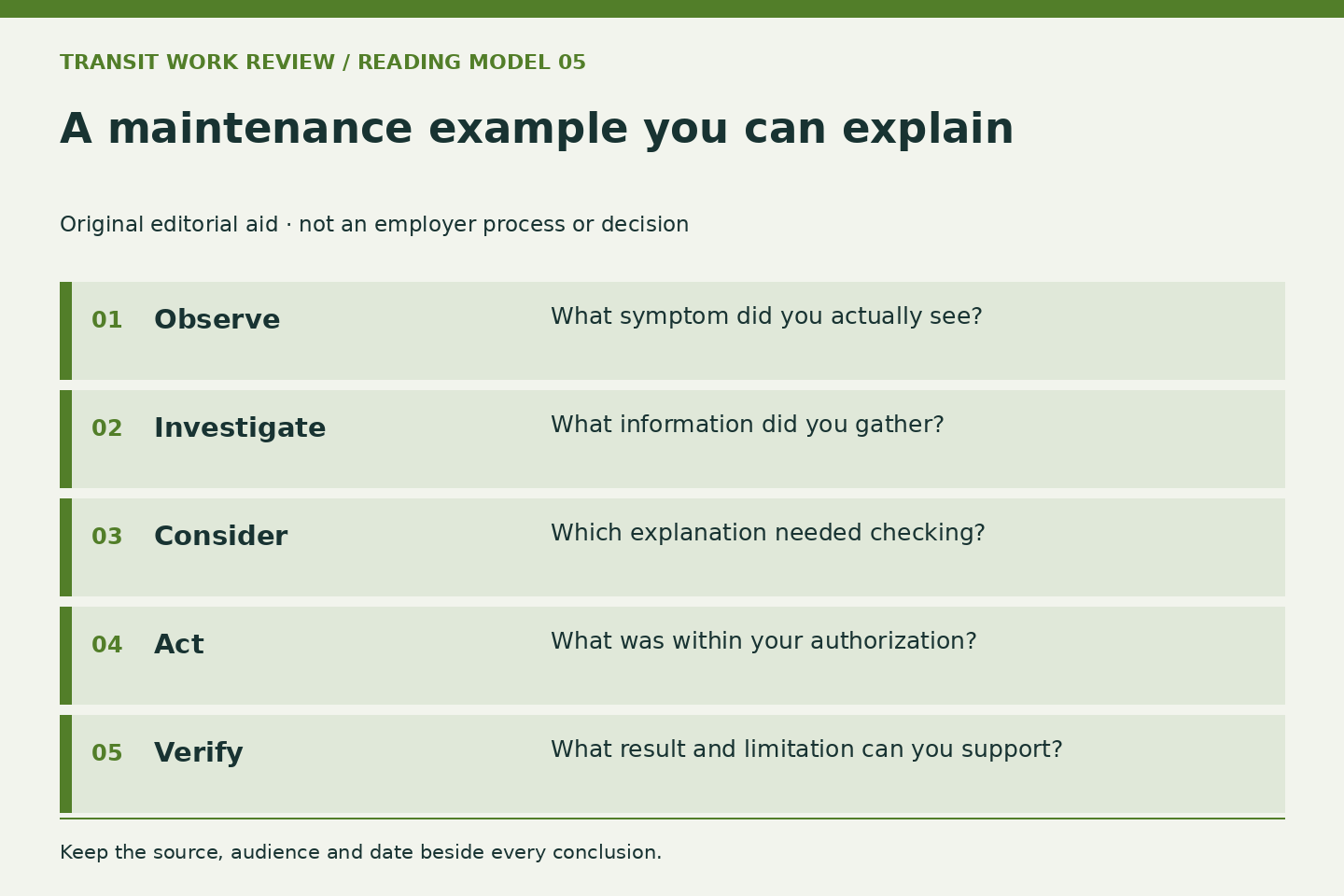
Write five lines: observed symptom, evidence collected, explanation considered, action within your responsibility, and verification. Include an uncertainty if one remained. Do not embellish a routine check into an independent engineering decision. If someone else approved the work or made the final diagnosis, identify that division of responsibility honestly.
For a hypothetical training exercise involving a non-operational practice device, the observation might be an intermittent fault rather than a constant failure. A good account explains how the learner recorded when it occurred and sought authorized guidance. It does not invent a clever shortcut or suggest that an unapproved adjustment was admirable. The learning evidence is disciplined observation and appropriate escalation.
Keep safety boundaries in the example
Career preparation should never encourage practicing on equipment without permission or copying internal maintenance material into a portfolio. Use lawful, authorized coursework, public examples and your own appropriately shareable descriptions. Avoid photographs that reveal restricted worksites, asset identifiers, security arrangements or another person's records.
If you cannot share the underlying document, describe the skill at a safe level. “I compared the recorded measurement with the approved specification and raised the discrepancy” can explain a habit without disclosing the specification. An interview answer can be informative while keeping proprietary details and operational procedures out of public circulation.
Turn gaps into a learning question
Compare the example with a current vacancy's actual requirements. Which part supports a listed responsibility? Which part is background only? What credential or experience still needs verification? The answer may suggest a course, supervised practice or another role to research, but this publication does not certify training quality or guarantee an employment pathway.
A completed evidence record should be short enough to explain clearly and precise enough to withstand follow-up questions. It should show the limits of your role as well as what you accomplished. In technical work, knowing when to stop, ask and verify is part of credible preparation, not an admission that the example has failed.
Continue reading: Rail careers: read the interfaces between roles, Ask about the pattern behind a schedule, Read an AI-recruiting notice for its actual scope.